
- Details
- Written by Alexis Evanoff
This page offers a behind-the-scenes look at how our augmented reality project about Josephine Butler was created. From early research to user testing and final refinements, these milestones show the process our team followed to bring Butler’s story to life in an interactive format. We include this not only for academic transparency, but also to share how much care, creativity, and collaboration went into honoring her legacy.
Milestone 1: Project Proposal & Early Planning
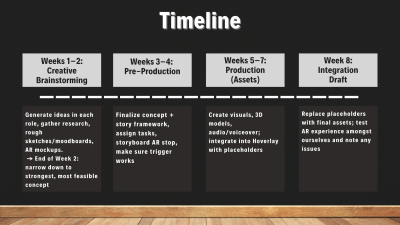
In the first weeks of the project, our team created a proposal outlining our goals, research focus, early design ideas, and production timeline. This included the first decisions about our roles, tools, and the overall structure of the AR experience.
Milestone 2: User Flow Development
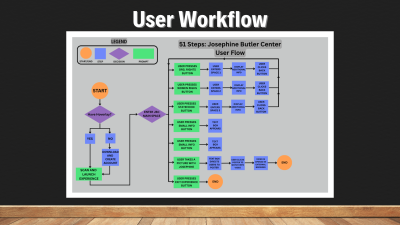
We created a complete user flow diagram showing how visitors would move through the AR experience. This mapped out the three core pathways—
-
Learn About Her History
-
Watch a Brief Video
-
Take a Photo With Her
—and helped us plan how each interaction would work once inside AR.
Milestone 3: Style Guide
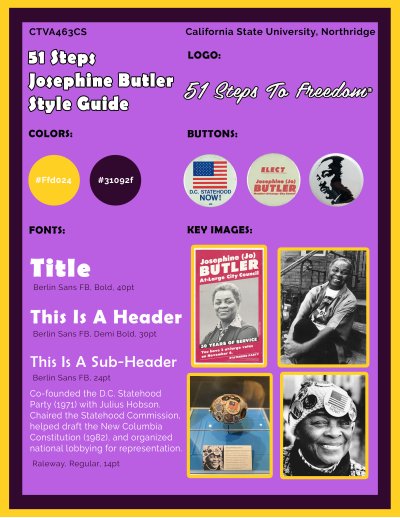
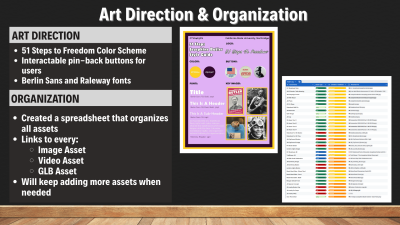
As part of our design process, we were given an initial style guide from the 51 Steps to Freedom Museum. While it provided a helpful starting point, our assignment required us to create a more comprehensive and unified visual system that would work cohesively between our work and the rest of the museum. We expanded and refined the visual language—color palette, typography, button styles, and imagery guidelines—so that it remained in harmony with the museum’s materials while better supporting clarity, accessibility, and historical tone. This early version of our updated style guide ensured consistency throughout the project and shaped the visual identity of the final experience.
Milestone 4: Mid-Term Progress
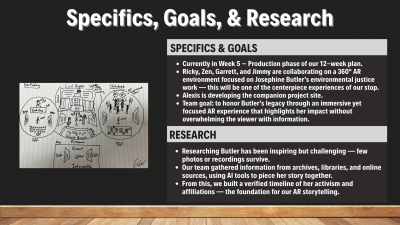
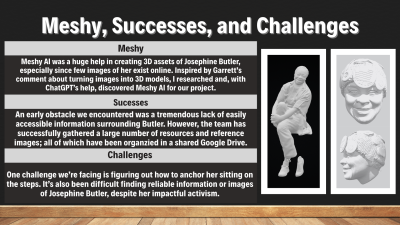
By mid-semester, we presented our early AR prototype, updated style guide, website progress, 3D assets, and research findings. This was the first time all project components—visuals, interactions, sound, and storytelling—came together.
Key midterm accomplishments included:
-
First AR test build with a working QR code
-
Initial 3D models (buttons, bust, building elements)
-
Early website pages
-
Draft of the interactive menu and structure
Milestone 5: User Testing & Improvements
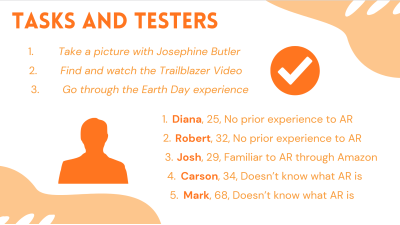
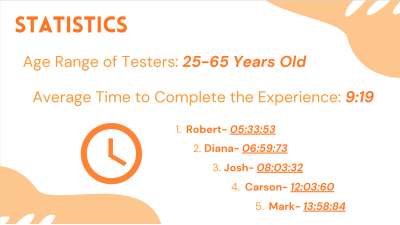
We conducted user testing with five participants ages 25–68, most of whom had never experienced AR. Each participant completed the same three tasks:
-
Take a picture with Josephine Butler
-
Watch the Trailblazer video
-
Go through the Earth Day experience
What users loved:
-
Feeling immersed in Butler’s history
-
Exploring 360° spaces
-
Seeing archival video in AR
-
The museum-like experience
What needed work:
-
Clearer instructions for navigation
-
More noticeable “return to menu” buttons
-
Guidance for taking the commemorative photo
-
Better readability for text boxes
-
Clearer indication that the hat buttons are interactive
Improvements we implemented:
-
Visual demos showing how to walk around the bust
-
Larger and shorter text panels
-
More prominent navigation buttons
-
Clearer onboarding instructions
-
Made interactive buttons easier to understand
REFLECTION
This project was built through ongoing research, prototyping, and community-minded design. Our goal was not only to meet academic requirements, but to create a digital experience that honors Josephine Butler’s work and provides visitors—whether they are in Washington, D.C. or anywhere else—with meaningful access to her story.
Our Process Page reflects that journey: from early sketches and ideas to a functioning AR installation grounded in history, empathy, and accessibility.
- Details
- Written by Alexis Evanoff

Alexis Evanoff
Project Manager / Website Content & Design
Alexis guided the team’s workflow and creative direction, ensuring that research and design decisions aligned with the museum’s mission. She coordinated communication, maintained team focus and morale, and integrated everyone’s contributions into a unified narrative. Alexis also designed and built the project website, creating a cohesive presentation for both the museum and public audiences.
Instagram: @alexisevanoff (Instagram Link) LinkedIn: Alexis Evanoff (LinkedIn Link)

Ricky Arenas
AR Builder
Ricky built the AR stop in Hoverlay and ensured it performed smoothly on-site in D.C. He implemented interactivity—text, images, and media triggers—and collaborated with the team to integrate visual and audio elements seamlessly, making the experience intuitive and immersive for users.
Instagram: @therickdawg (Instagram Link) LinkedIn: Richard Arenas (LinkedIn Link)

Zen Tapia
Researcher & 3D Asset Creator
Zen played a key role in both research and visual production, managing the creation of numerous 3D assets that populate the AR experience. His attention to historical accuracy and design consistency gave the project its visual identity and depth. Zen also fact-checked all research materials to ensure accuracy across the project.
Instagram: @zenful_edits (Instagram Link) LinkedIn: Zen Tapia (LinkedIn Link)

Garrett Wright
Art Director / Designer
Garrett defined the visual identity of the project, from color palette and typography to layout and design for both the AR environment and supporting visuals. He worked closely with Ricky and Zen to ensure that every element fit cohesively within the overall experience.
Instagram: @whatthefck_art (Instagram Link) LinkedIn: Garrett Wright (LinkedIn Link)
Jimmy Garcia
Audio/Video Lead
Jimmy co-led research and handled the editing and production of all video components in the project. He edited archival footage and clips used within the AR experience, including Trail Blazer: The Josephine Butler Story, and balanced the project’s soundscape to create a polished audiovisual experience.
Instagram: @ayeeejimmy (Instagram Link) LinkedIn: Jimmy Garcia (LinkedIn Link)
- Details
- Written by Alexis Evanoff
51 Steps to Freedom: Josephine Butler Parks Center AR Stop
Project Overview
51 Steps to Freedom: Josephine Butler Parks Center AR Stop is an augmented reality (AR) installation created using Hoverlay. The experience introduces visitors to Josephine Butler’s life and activism through interactive menus, historical media, and 3D storytelling. The AR stop can be explored on-site at the museum or remotely from any location.
Launch the Experience
Scan the QR Code to Begin

This QR code allows anyone to launch and explore the full AR experience, whether or not they are physically at the museum site.
Experience Walkthrough
The following visual walkthrough demonstrates how the AR stop works for visitors who cannot access the interactive version directly.
Introduction Menu
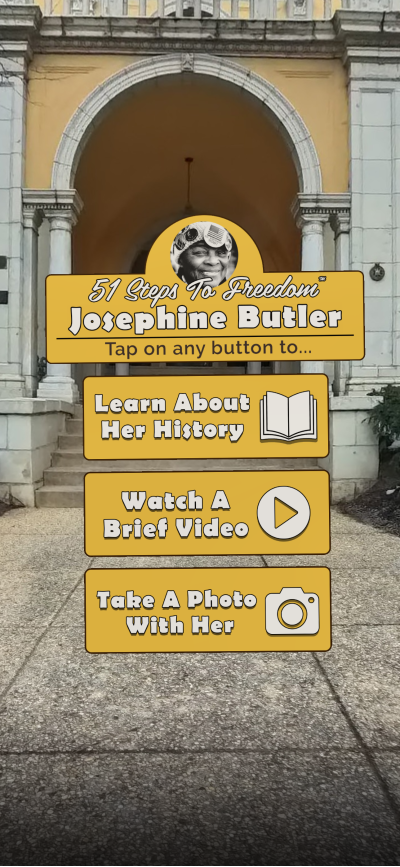
When the AR experience loads, visitors see a floating menu with three options:
-
Learn About Her History
-
Watch a Brief Video
-
Take a Photo With Her
Visitors may explore the experience in any order they choose.
OPTION 1 — Learn About Her History
A. Section Introduction
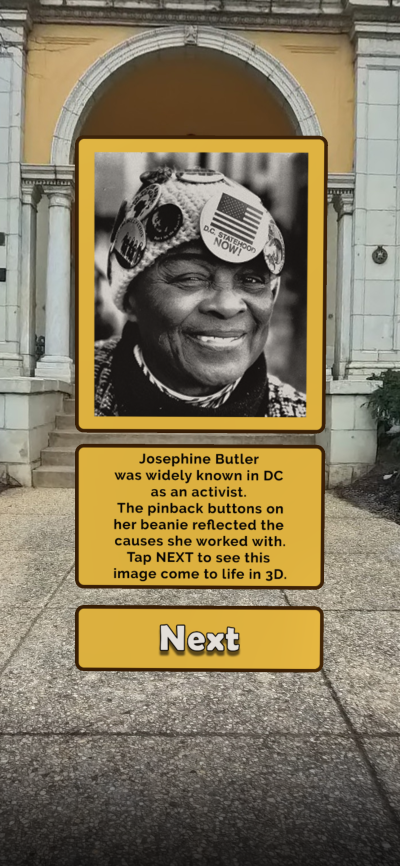
Selecting this option opens a brief explanation about Josephine Butler’s signature hat and the campaign buttons she wore — each representing a cause she supported.
B. Interactive Hat Buttons
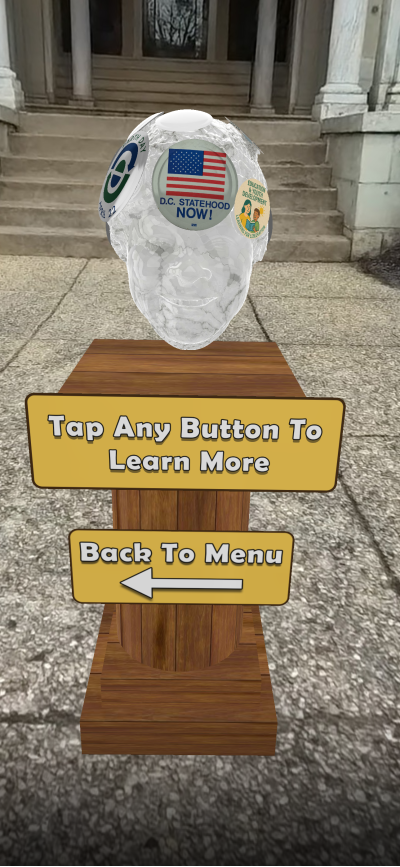
A 3D bust of Josephine Butler appears on a pedestal.
Only the buttons on her hat are highlighted in color and can be tapped.
Tapping each button reveals part of her life’s work.
1. Quick Information Cards (Most Buttons)
Most buttons open a short (under 25 words) information card describing the cause represented by that button, such as:
-
desegregation
-
environmental health
-
housing justice
-
ending apartheid
-
workers’ rights
These offer rapid, digestible insights into Butler’s activism.
2. Two Special Buttons: Immersive Video Experiences
D.C. Statehood Button
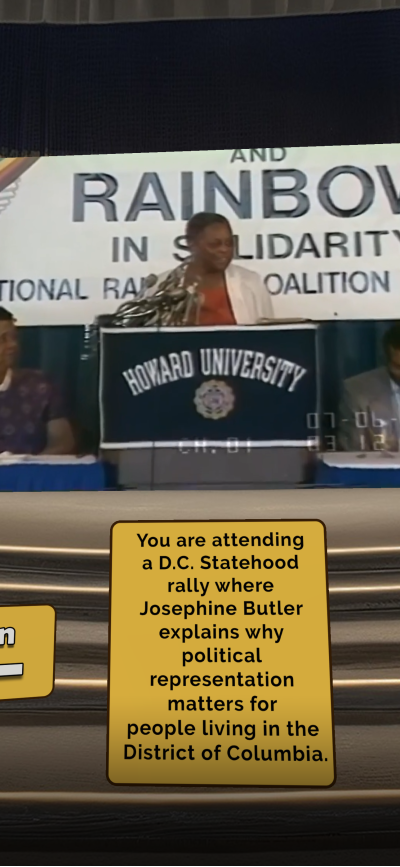
Tapping this button transports visitors into a digital recreation of the Howard University auditorium, where a 1990 archival video of Butler speaking plays.
This scene highlights her leadership in the D.C. Statehood movement.
Earth Day Button
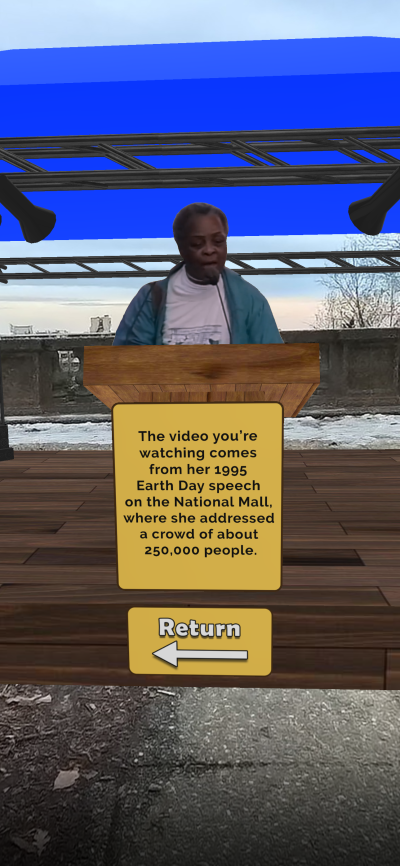
This button opens a scene set in Meridian Hill/Malcolm X Park, leading to archival footage from the 1997 Earth Day Rally at the National Mall.
This video underscores Butler’s environmental justice advocacy.
OPTION 2 — Watch a Brief Video
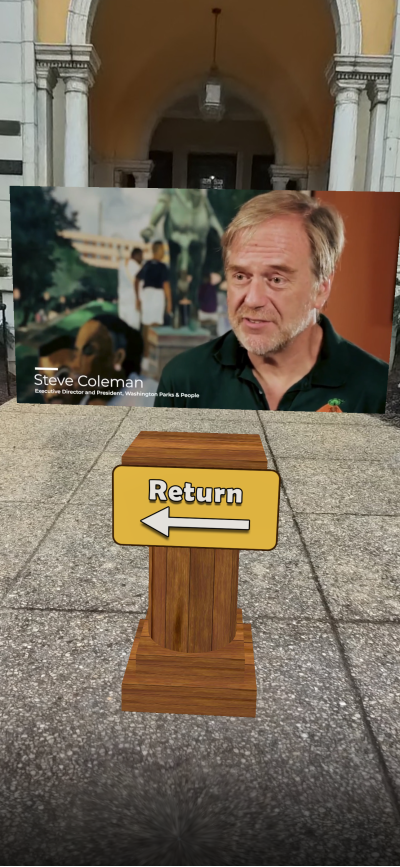
Visitors are taken to a digital podium displaying a short trailer for Trail Blazer: The Josephine Butler Story.
To the right of the trailer is a link to view the full mini-documentary in YouTube, offering a deeper exploration of Butler’s life and work.
OPTION 3 — Take a Photo With Her
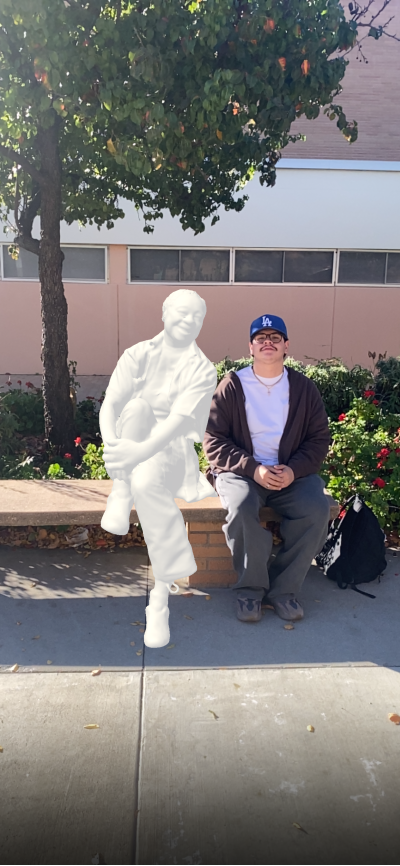
This option opens a 3D statue of Josephine Butler that visitors can place in their environment.
Instructions guide the user to:
-
Position the statue on the steps of the Josephine Butler Parks Center (or anywhere they choose)
-
Hand the phone to someone else
-
Pose beside the virtual Josephine Butler for a commemorative photo
This feature creates a personal moment of connection with Butler’s legacy.
About Josephine Butler
Josephine Butler (1920–1997) was a community organizer, civil rights advocate, and environmental justice leader whose work transformed Washington, D.C. She stood at the forefront of integration efforts in Adams Morgan, fought for D.C. statehood, and dedicated her life to empowering those without a voice.
Purpose
This AR stop was created to honor Butler’s decades of service and activism. Our goal was to create an accessible, interactive experience that reflects her commitment to justice, compassion, and community empowerment.
Credits
Produced by students in the Emerging Media Program,
Cinema and Television Arts Department,
California State University, Northridge.
Created for CTVA 463: Community Service Learning, Fall 2025.
Team:
Alexis Evanoff – Project Manager / Website Content & Design
Garrett Wright – Art Director / Designer
Ricky Arenas – AR Builder
Zen Tapia – Researcher & 3D Asset Creator
Jimmy Garcia – Audio / Video Lead
Community Partner: 51 Steps to Freedom Museum
AR Platform: Hoverlay
- Details
- Written by Alexis Evanoff
Commitment to Historical Accuracy
From the very beginning of this project, our team’s top priority was ensuring that the 51 Steps to Freedom: Josephine Butler Parks Center AR Stop would be historically accurate and worthy of Butler’s extraordinary life and work. Before creating any visuals or building any AR interactions, we spent a great deal of time gathering, reading, and cross-referencing materials from trusted archives, historians, and community organizations.
This page represents the foundation on which our entire project was built — a foundation of research, respect, and authenticity. Every element of our AR experience was developed to honor the legacy of Josephine Butler and to ensure that her story was told truthfully and with care.
Research Approach
Our process combined academic scholarship, public history, and community-based research. We drew from museum exhibitions, oral histories, news archives, and scholarly articles to accurately portray Butler’s decades of activism in Washington, D.C.
Josephine Butler’s leadership spanned housing rights, environmental justice, and D.C. statehood — all movements deeply connected to the lives of ordinary citizens. We found that, by far, the majority of the research materials revealed that her life was focused on her service to others rather than public recognition.
This research was not merely background information — it guided every design and storytelling choice we made. The tone, pacing, and imagery within the AR experience were all informed by the sources below.
Research & Sources
-
Kumfer, Timothy. “‘It’s in Our Hands to Build Our Country in Our Image’: Josephine Butler, D.C. Statehood, and the Everyday Work of Emancipation.” Washington History 36, no. 2 (Fall 2024): 46–59.
-
Butler, Josephine. “Education Position Paper.” 1976. Josephine Butler Papers, People’s Archive, DC Public Library.
-
Trail Blazer: The Josephine Butler Story. DCTV / Parks & People Foundation, 2019.
-
Butler, Josephine. Speech on D.C. Statehood. C-SPAN Video Library, July 5, 1990. Howard University, Washington, D.C.
-
Butler, Josephine. Earth Day Rally Speech. 1995 Earth Day 25th Anniversary Rally, Washington, D.C.
-
Hobson, Courtney C. “To Live and Breathe: Women and Environmental Justice in Washington, D.C.” The Public Historian 46 (1), 2024, pp. 166–171. University of California Press.
-
Geller, Joshua B. “Democratic Equality for Washington, D.C.” Perspectives on Politics, Cambridge University Press, 2025.
-
Smith, J. Y. “Josephine Butler Dies; Statehood Party Founder.” The Washington Post, March 29, 1997, p. B6.
-
Swift, Jamie A. “Josephine Butler and Environmental Activism in Washington, D.C.” Black Perspectives (AAIHS), January 13, 2018.
-
Comstock-Gay, Stu. “Interview with Josephine Butler.” The Washington Socialist, November–December 1984 (reprinted 2020).
-
“Josephine Butler: A Life of Service to the People of Washington, D.C.” The Washington Socialist, December 1997.
-
Women in History DowntownDC Callbox Tour. DC Preservation League, Washington, D.C.
-
DC Historic Marker: “Josephine Butler and the Integration of Adams Morgan.” Adams Morgan Heritage Trail, Cultural Tourism DC.
-
Interviews, articles, and community materials from the Josephine Butler Parks Center and Parks & People Foundation websites.
-
Archival imagery and public-domain materials related to Butler’s activism, used for reference in 3D and visual asset creation.
-
Local press coverage, museum texts, and oral-history materials providing social and political context for Butler’s work.
Closing Note
For our team, the research was a huge part of the creative act — the essential groundwork that allowed us to tell Josephine Butler’s story with honesty and depth. By centering our work on truth and service, we hope this AR experience honors the woman who spent her life doing exactly that.
- Details
- Written by Alexis Evanoff
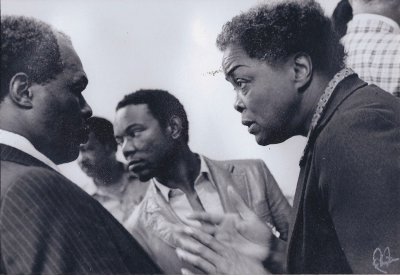
Josephine Butler (right) confronts DC Mayor Marion Barry, 1978 (Photo: Washington Parks & People).
Josephine Butler (1920–1997) spent her life fighting for people who were too often ignored — the poor, the working class, women, and Black residents of Washington, D.C. For more than fifty years, she was a force of nature: an organizer, a mentor, and a voice for those who had none.
Born in Brandywine, Maryland, Butler grew up in poverty in the shadow of Jim Crow. When she came to Washington as a young woman, she found work as a domestic laborer — one of the few options available to Black women at the time. The long hours and poor conditions didn’t silence her; they strengthened her sense of purpose. She began organizing with other workers, demanding respect, fair pay, and safe workplaces. It was there, in the laundries of the city, that she discovered her life’s calling: to fight for justice from the ground up.
Through the 1950s, ’60s, and ’70s, Butler became one of Washington’s most determined and visionary community leaders. At a time when segregation and racial tension divided the city, she stood at the forefront of integration in D.C. Working from her base in the Adams Morgan neighborhood, Butler helped lead efforts to desegregate schools, housing, and public spaces, building coalitions that united residents of every stripe around a shared vision of equality and self-determination.
Her work in Adams Morgan was transformative. Butler organized tenant associations, challenged discriminatory landlords, and co-founded neighborhood councils that gave local residents — especially working-class families — a voice in city decisions that had long excluded them. She believed that real democracy started on the block level, with neighbors coming together to solve problems and share power.
Butler believed in inclusive leadership. Many of the people she organized alongside and mentored were women — neighbors, mothers, and community workers — whose voices had rarely been heard in public spaces. She understood that empowering women within their communities was essential to building lasting social change.
In 1971, Butler helped found the D.C. Statehood Party, a political movement dedicated to securing full representation for Washington’s citizens. For Butler, this was more than a constitutional issue — it was a moral one. She saw the denial of self-governance in the nation’s capital as an injustice that silenced a predominantly Black city. She spent decades campaigning for D.C. statehood, speaking at rallies and community gatherings, and urging others to see democracy not as an abstraction, but as something that must be practiced every day.
By the 1980s and 1990s, Butler turned much of her attention to environmental justice, long before the term was widely used. She saw how pollution, unsafe housing, and lack of green space harmed low-income communities the most. Working with the Parks & People Foundation, which she helped found, she fought to clean up parks, protect public spaces, and connect environmental health with racial and economic equality. She believed that clean air, safe water, and access to nature were not luxuries — they were civil rights.
What made Josephine Butler extraordinary wasn’t just the breadth of her activism — it was her spirit. She didn’t seek titles or fame. She believed that change happened in the everyday acts of service: in listening, organizing, showing up, and refusing to give up. She once carried a small bell with her, inspired by Queen Juliana of the Netherlands’ words: “We must always listen to the smallest bells, for they are symbols of justice.” For Butler, those “smallest bells” were the voices of her community — and she never stopped listening.
Today, her legacy endures in the Josephine Butler Parks Center in Adams Morgan, a gathering place for civic and environmental organizations. Her life reminds us that activism is not about recognition — it’s about service, courage, and compassion in the face of inequality.