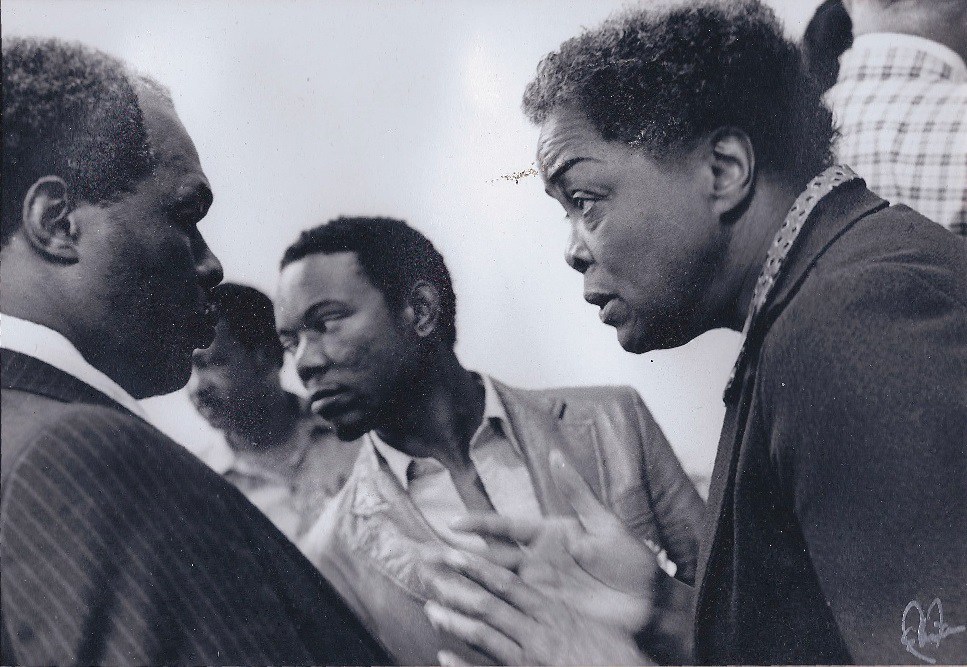
Josephine Butler (right) confronts DC Mayor Marion Barry, 1978 (Photo: Washington Parks & People).
Josephine Butler (1920–1997) spent her life fighting for people who were too often ignored — the poor, the working class, women, and Black residents of Washington, D.C. For more than fifty years, she was a force of nature: an organizer, a mentor, and a voice for those who had none.
Born in Brandywine, Maryland, Butler grew up in poverty in the shadow of Jim Crow. When she came to Washington as a young woman, she found work as a domestic laborer — one of the few options available to Black women at the time. The long hours and poor conditions didn’t silence her; they strengthened her sense of purpose. She began organizing with other workers, demanding respect, fair pay, and safe workplaces. It was there, in the laundries of the city, that she discovered her life’s calling: to fight for justice from the ground up.
Through the 1950s, ’60s, and ’70s, Butler became one of Washington’s most determined and visionary community leaders. At a time when segregation and racial tension divided the city, she stood at the forefront of integration in D.C. Working from her base in the Adams Morgan neighborhood, Butler helped lead efforts to desegregate schools, housing, and public spaces, building coalitions that united residents of every stripe around a shared vision of equality and self-determination.
Her work in Adams Morgan was transformative. Butler organized tenant associations, challenged discriminatory landlords, and co-founded neighborhood councils that gave local residents — especially working-class families — a voice in city decisions that had long excluded them. She believed that real democracy started on the block level, with neighbors coming together to solve problems and share power.
Butler believed in inclusive leadership. Many of the people she organized alongside and mentored were women — neighbors, mothers, and community workers — whose voices had rarely been heard in public spaces. She understood that empowering women within their communities was essential to building lasting social change.
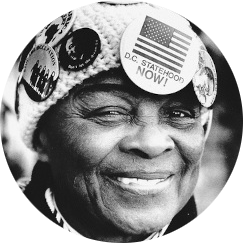
In 1971, Butler helped found the D.C. Statehood Party, a political movement dedicated to securing full representation for Washington’s citizens. For Butler, this was more than a constitutional issue — it was a moral one. She saw the denial of self-governance in the nation’s capital as an injustice that silenced a predominantly Black city. She spent decades campaigning for D.C. statehood, speaking at rallies and community gatherings, and urging others to see democracy not as an abstraction, but as something that must be practiced every day.
By the 1980s and 1990s, Butler turned much of her attention to environmental justice, long before the term was widely used. She saw how pollution, unsafe housing, and lack of green space harmed low-income communities the most. Working with the Parks & People Foundation, which she helped found, she fought to clean up parks, protect public spaces, and connect environmental health with racial and economic equality. She believed that clean air, safe water, and access to nature were not luxuries — they were civil rights.
What made Josephine Butler extraordinary wasn’t just the breadth of her activism — it was her spirit. She didn’t seek titles or fame. She believed that change happened in the everyday acts of service: in listening, organizing, showing up, and refusing to give up. She once carried a small bell with her, inspired by Queen Juliana of the Netherlands’ words: “We must always listen to the smallest bells, for they are symbols of justice.” For Butler, those “smallest bells” were the voices of her community — and she never stopped listening.
Today, her legacy endures in the Josephine Butler Parks Center in Adams Morgan, a gathering place for civic and environmental organizations. Her life reminds us that activism is not about recognition — it’s about service, courage, and compassion in the face of inequality.